Showing posts with label Book Challenges. Show all posts

Friday, March 16, 2012

The Classics Club


Jill at A Room of One's Own has created The Classics Club. This fits in perfectly with my intention to read more Classics, especially ones already on my shelves.

I might read more than what is listed below, but I don't want to over commit (I tend to do that). With that in mind, I plan to read 50 Classics in the next 5 years. That means I should have this reading list completed in March 2017. I have put a few rereads on the list, but didn't want to include too many. All of the rereads are books that I read a long time ago. My reading of David Copperfield goes back the furthest -- I read it when I was 8 years old; and, no, I won't tell you how old I am now!

I honestly can't tell you which title I most look forward to reading. It would probably be a tie between: Don Quixote, the Trollope titles, and Ethan Frome. These are books I've wanted to read for the longest time. But, then there is the The Arabian Nights ... and Beowulf ... the Forster books .... See what I mean?

I will probably gift myself a lovely edition of a wonderful book when I'm finished reading this list, but I have 5 years to decide and change my mind multiple times.

Without further ado ... THE LIST:

  1. Alcott, Louisa May - Little Women (reread)
  2. Arabian Nights, The (trans. Muhsin Mahdi)
  3. Ariosto, Ludovico - Orlando Furioso
  4. Austen, Jane - Sense and Sensibility
  5. Barnes, Julian - Flaubert's Parrott
  6. Beowulf (trans. Seamus Heaney)
  7. Bradley, Marion Zimmer - The Mists of Avalon (reread)
  8. Bronte, Anne - The Tenant of Wildfell Hall
  9. Bulgakov, Mikhail - The Master and Margarita (reread)
  10. Burnett, Frances Hodgson - The Secret Garden
  11. Campbell, Joseph - The Hero with a Thousand Faces (reread)
  12. de Cervantes, Miguel - Don Quixote
  13. Cheever, John - Oh What a Paradise It Seems
  14. Colette - Cheri
  15. Collins, Wilkie - The Haunted Hotel
  16. Collins, Wilkie - Miss or Mrs?
  17. Dickens, Charles - Great Expectations
  18. Dickens, Charles - David Copperfield (reread)
  19. Dickens, Charles - A Tale of Two Cities
  20. Dostoyevsky, Fyodor - The Brothers Karamazov (trans. Pevear & Volokhonsky)
  21. Durrell, Lawrence - Justine (Alexandria Quartet)
  22. Durrell, Lawrence - Balthazar (Alexandria Quartet)
  23. Durrell, Lawrence - Mountolive (Alexandria Quartet)
  24. Durrell, Lawrence - Clea (Alexandria Quartet)
  25. Forster, E.M. - Howard's End
  26. Forster, E.M. - The Longest Journey
  27. Forster, E.M. - A Passage to India (reread)
  28. Forster, E.M. - Where Angels Fear to Tread (reread)
  29. Gaskell, Elizabeth - Cranford
  30. Gaskell, Elizabeth - North and South
  31. Hardy, Thomas - The Mayor of Casterbridge
  32. Homer - The Odyssey (reread)
  33. Hugo, Victor - Notre-Dame of Paris (The Hunchback of Notre Dame)
  34. Mitchell, Margaret - Gone With the Wind
  35. Polidori, John - The Vampyre
  36. Radcliffe, Anne - The Mysteries of Udolpho
  37. Spenser, Edmund - The Faeire Queene
  38. Stendhal - The Red and the Black
  39. Stevenson, Robert Louis - Treasure Island
  40. Thackeray, William Makepeace - Vanity Fair
  41. Tolstoy, Leo - Anna Karenina (trans. Pevear & Volokhonsky) (reread)
  42. Trollope, Anthony - Barchester Towers
  43. Trollope, Anthony - The Warden
  44. Twain, Mark - A Connecticut Yankee in King Arthur's Court
  45. Verne, Jules - Journey to the Centre of the Earth
  46. Virgil - The Aeneid (reread)
  47. Wharton, Edith - The Age of Innocence
  48. Wharton, Edith - Ethan Frome
  49. Woolff, Virginia - Mrs. Dalloway
  50. Woolff, Virginia - A Room of One's Own (reread)
I'm currently reading Clarissa by Samuel Richardson as part of a year long group read with JoAnn and others.

Friday, March 02, 2012

The Winter Queen by Boris Akunin

Setting and basic plot

The Winter Queen is set in 1870s Moscow, St. Petersburg, and London and features Boris Akunin's sleuth, Erast Fandorin. Fandorin is a young paper pusher for a criminal investigative unit. He is quite bored with clerking and jumps at the chance to investigate the suicide of a wealthy student. Fandorin's superior believes this to be an open and shut case -- though a bit curious -- and sends his young clerk off to investigate. In the course of his investigation, Fandorin stumbles into a vast and international revolutionary conspiracy.

Language and writing

The language and writing are sometimes quite glorious. For instance, here is the opening line:

"On Monday the thirteenth of May in the year 1876, between the hours of two and three in the afternoon on a day that combined the freshness of spring with the warmth of summer, numerous individuals in Moscow's Alexander Gardens unexpectedly found themselves eyewitnesses to the perpetration of an outrage that flagrantly transgressed the bounds of common decency."

Random thoughts

As I read The Winter Queen, I kept thinking, "Wow. This is so Russian. This author writes like a Russian. Wow." Then I would remind myself that Boris Akunin IS Russian with a wonderful translator. I believe what kept throwing me was how reminiscent of 19th century Russian authors Akunin seemed. More specifically, Akunin reminded me of Gogol and Chekhov -- a bit romantic and moody, a bit surreal, with a touch of the grotesque. This particular combination has the overall effect of discreet humor. There was also a Sherlockian sense about the novel with a focus on Fandorin's deductive reasoning. Fandorin must peel back multiple layers and each layer changes the "landscape" so that he must reorient and deduce again. Oh, and Fandorin has a nemesis.

Characterization

Fandorin is naive and likeable in this opener to the series, but expect him to develop over the life of the series.

The "bad guys" are easy enough to spot, but interesting. How many authors write in a pedagogical puppeteer and "revolution through education"? I don't want to say too much and spoil it for future readers, but there are definitely some interesting characters.

The ending and a look to the future

The ending is bittersweet, but allows one to anticipate the next in the series. I look forward to reading more of Akunin's Erast Fandorin books to see how he develops this character and to experience some more of that "Oh yeah, this IS a Russian novel" surprise. *smile*


I read this for the Merely Mystery Reading Challenge hosted by Literary Feline.

Saturday, January 14, 2012

A Morbid Taste for Bones by Ellis Peters

Title: A Morbid Taste for Bones (Book One of the Brother Cadfael Mysteries)
Author: Ellis Peters
Year: 1977

Synopsis: "In the remote Welsh mountain village of Gwytherin lies the grave of Saint Winifred. Now, in 1137, the ambitious head of Shrewsbury Abbey had decided to acquire the sacred remains for his Benedictine order. Native Welshman Brother Cadfael is sent on the expedition to translate and finds the rustic villagers of Gwytherin passionately divided by the Benedictine's offer for the saint's relics. Canny, wise, and all too worldly, he isn't surprised when this taste for bones leads to bloody murder. The leading opponent to moving the grave has been shot dead with a mysterious arrow, and some say Winifred herself held the bow. Brother Cadfael knows a carnal hand did the killing. But he doesn't know that his plan to unearth a murderer may dig up a case of love and justice... where the wages of sin may be scandal or Cadfael's own ruin." (from the back cover)

I tend to read mysteries during the winter season. I'm not sure why that is exactly, but there is something about the early darkness and the cold that makes me want to curl up under my reading lamp with a cup of hot tea and become immersed in the puzzling, unknown, and strange. Perhaps it is the idea of something enigmatic, covert, or cryptic that seems to set so well with me when it is dark and cold. The season just seems to match the atmosphere.

With all that said, A Morbid Taste for Bones is pretty low key as far as mysteries go. There is no gore, nor is the tension terribly high, and what excitement there is comes mainly at the end. I was a bit surprised that the physical historical setting is not a great focus. Instead, Peters chooses to focus on the main character, Brother Cadfael, a Benedictine monk, and the politics and power plays of the Medieval church.

Peters wrote the Brother Cadfael series later in her life. Perhaps this gave her a greater ability to empathize with her older character, because she captured him well. Cadfael has joined the cloister as a "retirement job." He has already lived a very worldly life. This makes him a perceptive, patient, and watchful personality. He understands the ambitions and motivations of others, and this makes him good at solving crime.

Cadfael also has a wry sense of humor. In one scene, he is listening to a younger Brother rant about the ambitions of their Prior and his plans to dig up the bones of a saint and bring them back to the Abbey as relics. While we get the impression that Cadfael does indeed find this activity a bit repulsive, he can not be overtly subversive:

"I don't see why they should want to dig up the poor lady's dust. It seems like charnel-house business to me, not church business. And you think exactly the same," he said firmly, and stared out his elder, eye to eye.

"When I want to hear my echo," said Brother Cadfael, "I will speak first."

I like Brother Cadfael not only for his wry humor, but also for his quiet subversiveness. As I mentioned above, Cadfael is not young and inexperienced. He understands the need to work within a quite intermingled societal and religious structure, but he comprehends all too well the harm that comes from power plays by the ruling bodies, both "prince" and "bishop." His subversiveness flows from his compassion and sense of justice.

"It was a long time since he had exercised some of his more questionable skills, he was glad to be confirmed in believing that he had forgotten none of them, and that every one had a meritorious use in the end."

I am very excited to read more of the Brother Cadfael mysteries! If you are looking for a well paced novel with a very likable main character and a Medieval setting, then you might just like this series too.

Also reviewed by: things mean a lot


I read this for the Merely Mystery Reading Challenge hosted by Literary Feline.

Sunday, January 08, 2012

TSS: Merely Mystery Reading Challenge 2012


I mentioned in a previous post that I would be participating in the Merely Mystery Reading Challenge hosted by Literary Feline at Musings of a Bookish Kitty. I'm trying to be judicious with the challenges I join for a number of reasons. Mainly, I tend to do the reading part of the challenge, but then don't write any blog posts or visit others participating in the challenge. This defeats a great part of the challenge - the social part!

One of the criteria for joining a reading challenge this year is whether or not reading for that challenge will contribute to one of my main reading goals for 2012 - to read down my TBR collection. I've noticed a lot of others have this same goal. (I think we've been enabling each other!) The Merely Mystery Reading Challenge fits this goal and sounds like so much fun. It will also provide reading that contrasts nicely with the year long Clarissa Group Read.

I really appreciate the way Literary Feline has provided a very nice breakdown of the Mystery sub-genres. Sub-genres like: The Whodunit, Locked Room Mystery, Cozy, and others. You really should take a look at these descriptions, even if you're not participating.

Some of the authors and/or series that I'll be pulling from for this challenge are:

  • Sherlock Holmes mysteries by Sir Arthur Conan Doyle
  • Brother Cadfael mysteries by Ellis Peters
  • Various P.D. James mysteries
  • Inspector Banks mysteries by Peter Robinson
  • Various Agatha Christie mysteries
  • Various J.A. Jance mysteries
  • Anna Pigeon mysteries by Nevada Barr
  • Hamish Macbeth mysteries by M.C. Beaton
  • Elvis Cole & Joe Pike mysteries by Robert Crais

I'm sure there are more on my shelves, but this is a fair representation of what I'll be reading for this challenge. I do want to dig through my stacks and see if I've got some pre-twentieth century mysteries to read (besides Sherlock Holmes). I've had a craving to read some older literature this year. I'm guessing it has something to do with reading quite a bit of YA (young adult) fiction and contemporary paranormal fiction last year. It's been a while since I've read many classics ... but I'm getting ahead of myself. That is an entirely different post!

The Sunday Salon.com

Wednesday, January 04, 2012

The TBR Double Dare


The TBR Double Dare

C.B. James threw out the dare and I'm going to take it on! If you remember from my reading goals and challenges post, I mentioned that a top goal for me is to read from my mountainous to-be-read collection. This dare nicely aligns with that goal.

The dare is simply to "make a resolution to read only the books in your To Be Read stack from January 1, 2012 to April 1."

This is not a book buying ban but is, instead, a dare to only read books from my TBR collection during the stated time period. As of 12:00 am January 1, no newly purchased books and no borrowed books can be read until April 1. Of course, it would be helpful if I didn't buy any books during that time as well, but that is a separate issue!

At least this wasn't a double dog dare or, gasp, the dreaded triple dog dare! Wish me luck.

Monday, September 19, 2011

The Halloween Tree by Ray Bradbury

Once again Bradbury writes a story that is poetry disguised as prose. He beautifully evokes the sights and sounds and smells of childhood. In this case, it is the childhood of an autumn night, Halloween to be exact.

"The wind outside nested in each tree, prowled the sidewalks in invisible treads like unseen cats.

Tom Skelton shivered. Anyone could see that the wind was a special wind this night, and the darkness took on a special feel because it was All Hallows' Eve. Everything seemed cut from soft black velvet or gold or orange velvet. Smoke panted up out of a thousand chimneys like the plumes of funeral parades. From kitchen windows drifted two pumpkin smells: gourds being cut, pies being baked.

The cries behind the locked house doors grew more exasperated as shadows of boys flew by windows. Half-dressed boys, greasepaint on their cheeks; here a hunchback, there a medium-size giant. Attics were still being rummaged, old locks broken, old steamer chests disemboweled for costumes."


This is a tale that one might have heard told around a crackling campfire on an October night. The kind that makes you jump at the sound of a twig snapping and makes you look repeatedly over your shoulder into the darkness that writhes with shadows cast by the firelight.

Eight boys in costume, turned loose on their small town on Halloween night. A haunted house. A giant tree full of Jack-o lanterns that light up and grin out at the night. A mysterious man named Carapace Clavicle Moundshroud to tell them the "wild long history of Halloween."

"... the front door gave a shake, a twist of its knob, a grimace of its Marley knocker, and flung itself wide.

The wind made by the suddenly opening door almost knocked the boys off the porch. They seized one another's elbows, yelling.

Then the darkness within the house inhaled. A wind sucked through the gaping door. It pulled at the boys, dragging them across the porch. They had to lean back so as not to be snatched into the deep dark hall. They struggled, shouted, clutched the porch rails. But then the wind ceased.

Darkness moved within darkness.

Inside the house, a long way off, someone was walking toward the door. Whoever it was must have been dressed all in black for they could see nothing but a pale white face drifting on the air.

An evil smile came and hung in the doorway before them.

Behind the smile, the tall man hid in shadow. They could see his eyes now, small pinpoints of green fire, in little charred pits of sockets, looking out at them."


The illustrations by Joseph Mugnaini that appear throughout The Halloween Tree are shiveringly appropriate for the story told by Bradbury. The artist captures that slightly skewed angle that changes the normal into the creepy and the daytime into night. These are images that you might see in your dreams, or, if you look closely ... on All Hallows' Eve.

Carl V. at Stainless Steel Droppings is hosting the R.I.P. reading challenge again this year. The Halloween Tree would be an excellent read for those readers wishing to imbibe peril! Below are some links for R.I.P.

About the R.I.P. reading challenge
The R.I.P. VI Review Site

Monday, March 28, 2011

Once Upon a Time: Vlog!

I thought I'd vlog my reading pile this year for Carl V.'s Once Upon a Time reading challenge.


The Once Upon a Time reading challenge is a "journey together into the magical lands of fantasy, fairy tales, folklore and mythology" and runs from March 21st through June 20th. I love Carl's rules for the challenge:

Rule #1: Have fun.
Rule #2: Have fun.
Rule #3: Don’t keep the fun to yourself, share it with us, please!
Rule #4: Do not be put off by the word “challenge”.

There are several levels at which to participate, so join the one that works for you. I will be taking The Journey. This means that I will be commiting to read at least one book from the four categories (fantasy, fairy tales, folklore, mythology).

Hope to see you there!

Wednesday, October 13, 2010

Fevre Dream by George R. R. Martin

Fevre Dream has got to be one of the best vampire novels I've ever read. I found myself caring deeply about the main characters ... a human, a vampire, and a steamboat. Yes, you heard me correctly. I cared very much about the steamboat. The story takes place in the mid 1800s primarily on the Mississippi River. The settings, whether on the steamboat navigating the River or on a plantation in the Deep South, were incredibly evocative of a different time and place. I could feel the settings. I was there.

I can't tell you too much about the vampires without giving away George R. R. Martin's particular take on these supernatural beings. I will tell you though that I was intrigued.

The internal conflicts that I've found in the vampires of certain other authors was also present here -- a veritable war within to try and keep a driving and consuming evil at bay. Beauty and the creation of beauty is an important theme in Fevre Dream. The deep longing to create beauty and great shame of the need that drives them to barbaric acts makes some of Martin's vampires quite sympathetic characters.

Martin interweaves commentary on slavery into his story in some rather surprising ways. What is not surprising is the truth of slavery, which the author does not let us avoid. He presents us with a world in which some are enslaved because they are different and therefore, somehow, lesser. He makes us look, with eyes wide open, at the acts of cruelty by those who would use and destroy others; those who would obliterate what someone else has created and would, without compunction, annihilate beauty for no better reason than their self perceived superiority and ability to do so.

Fevre Dream is an incredibly moving story of a desire for unity, dreams of immortality, and the legendary times of the steamboat era. If you are looking for another book to read for the R.I.P. challenge, I highly recommend Fevre Dream.

Below are just a few of my favorite bits ...

I read this description of York several times because I was so stunned by the author's ability to describe his character so poetically:

"Whatever thoughts he had had, whatever plans he had made, were sucked up in the maelstrom of York's eyes. Boy and old man and dandy and foreigner, all those were gone in an instant, and there was only York, the man himself, the power of him, the dream, the intensity.

York's eyes were gray, startlingly dark in such a pale face. His pupils were pinpoints, burning black, and they reached right into Marsh and weighed the soul inside him. The gray around them seemed alive, moving like fog on the river on a dark night, when the banks vanish and the lights vanish and there is nothing in the world but your boat and the river and the fog. In those mists, Abner Marsh saw things; visions swift-glimpsed and then gone. There was a cool intelligence peering out of those mists. But there was a beast as well, dark and frightening, chained and angry, raging at the fog. Laughter and loneliness and cruel passion; York had all of that in his eyes." pp. 2-3

I don't have any particular interest in steamboats from the 1850s, but this description is absolutely beautiful and truly took my breath away:

"Where is our boat, then?"

Come this way," Marsh said, gesturing broadly with his walking stick. He led them half across the boatyard. "There," he said, pointing.

The mists gave way for them, and there she stood, high and proud, dwarfing all the other boats around her. Her cabins and rails gleamed with fresh paint pale as snow, bright even in the gray shroud of fog. Way up on her texas roof, halfway to the stars, her pilot house seemed to glitter; a glass temple, its ornate cupola decorated all around with fancy woodwork as intricate as Irish lace. Her chimneys, twin pillars that stood just forward of the texas deck, rose up a hundred feet, black and straight and haughty. Their feathered tops bloomed like two dark metal flowers. Her hull was slender and seemed to go on forever, with her stern obscured by the fog. Like all the first-class boats, she was was a side-wheeler. Set amidship, the huge curved wheelhouses loomed gigantic hinting at the vast power of the paddle wheels concealed within them. They seemed all the larger for want of the name that would soon be emblazoned across them.

In the night and the fog, amid all those smaller plainer boats, she seemed a vision, a white phantom from some riverman's dream. She took the breath away ..." p. 21

The rot of the South; rot under the beauty:

"By their seventh night in New Orleans, Abner Marsh felt strangely sick of the city, and anxious to be off. That night Joshua York came down to supper with some river charts in his hand. Marsh had seen very little of his partner since the arrival. "How do you fancy New Orleans?" Marsh asked York as the other seated himself.

"The city is lovely," York replied in an oddly troubled voice that made Marsh look up from the roll he was buttering. "I have nothing but admiration for the Vieux Carre. It is utterly unlike the other river towns we've seen, almost European, and some of the houses in the American section are grand as well. Nonetheless, I do not like it here."

Marsh frowned. "Why's that?"

"I have a bad feeling, Abner. This city -- the heat, the bright colors, the smells, the slaves -- it is very alive, this New Orleans, but inside I think it is rotten with sickness. Everything is so rich and beautiful here, the cuisine, the manners, the architecture, but beneath that ..." He shook his head. "You see all those lovely courtyards, each boasting an exquisite well. And then you see the teamsters selling river water from barrels, and you realize that the well water is unfit to drink. You savor the rich sauces and spices of the food, and then you learn that the spices are intended to disguise the fact that the meat is going bad. You wander through the St. Louis and cast your eyes upon all that marble and that delightful dome with the light pouring through it down onto the rotunda, and then you learn it is a famous slave mart where humans are sold like cattle. Even the graveyards are places of beauty here. No simple tombstones or wooden crosses, but great marble mausoleums, each prouder than the last, with statuary atop them and fine poetic sentiments inscribed in stone. But inside every one is a rotting corpse, full of maggots and worms. They must be imprisoned in stone beacause the ground is no good even for burying, and graves fill up with water. And pestilence hangs over this beautiful city like a pall.

"No, Abner," Joshua said with an odd, distant look in his gray eyes, "I love beauty, but sometimes a thing lovely to behold conceals vileness and evil within." pp. 114-115


This is another book not on my challenge list, but will count as one of my reads for the R.I.P. V Challenge.

Tuesday, September 28, 2010

Real World by Natsuo Kirino

Real World by Natsuo Kirino can be labeled a psychological thriller, but I think it goes a bit deeper than that. It is a coming of age story that focuses on the expectations and pressures placed upon teens in contemporary Japan.

The central plot is the murder of a mother by her son, but the real story is the response to this murder by a clique of four teenage girls. Full of angst and despair, they become involved in the aftermath of this horrific event.

The story is told by five alternating first person narratives, that of a boy (the murderer) and four girls (the clique). This constantly shifting point of view is quite jarring, but in the context of the story this is probably a very appropriate technique. The story is jarring. The events in the story are so extreme that they seem unreal, but those events are more real than the superficial everyday lives of the adults.

There are two worlds in Real World. The superficial adult world and the angsty, nihilistic adolescent world. The adults can not connect with each other because of superficiality. The teens struggle to escape the superficial burdens of adulthood being forced upon them creating alienation and hostility between the generations. The teens are unable to connect with each other as they hide their true selves thinking that no one would truly understand them. There is a complete disconnection between any of the characters. I kept thinking of E.M Forster and "only connect" as I read Real World. I know I'm taking that phrase out of context, but if the characters could only connect ....

The atmosphere of Real World is oppressive. I would label this novel as extreme noir and, unlike Out, Kirino never breaks up this story with black comedy. The nihilism in Real World was almost unbearable and I really couldn't wait to get to the end of the story. I am glad I read to the end though ... there is a glimmer of hope.
This counts toward my reading for Japanese Literature Challenge 4

Wednesday, September 22, 2010

The Gates by John Connolly

Eleven year old "Samuel Johnson and his dachshund, Boswell, are trying to show initiative by trick-or-treating a full three days before Halloween, which is how they come to witness strange goings-on at 666 Crowley Road."
-- Blurb from book cover

The Gates by John Connolly had me laughing and reading bits and pieces out loud to my husband for the entire book. Yes ... there are demons, witchcraft dabblers, The Great Malevolence, mayhem, and the possible end-of-the-world. I know these are not typically characters and topics that one would think of as funny, but in Connolly's hands they are screamingly so. It helps that there is a narrator who pops in, mainly in the footnotes ... Let me stop here for a moment and discuss the footnotes bit. I find footnotes to be quite distracting and usually do not appreciate them in my fiction. Heck, I can hardly stand them when I'm reading scholarly material, but I understand the necessity in that venue. But the footnotes Connolly writes into The Gates add to the hilarity. I couldn't help hearing the musical jingle from Hitchhikers Guide to the Galaxy fade in and out as I read the footnotes. I also couldn't help hearing the narrator's voice from Hitchhikers Guide to the Galaxy when I read the footnotes. I can probably attribute this to the fact that in both Hitchhikers Guide and The Gates the narrator is trying to explain the outrageous that really can't be explained. So, what I'm trying to say is that I didn't find the footnotes to be a distraction at all and thought they made the book even funnier. Anyway, moving on from the footnotes ...

Young Samuel Johnson is a little boy that you can't help but love. He is rather nerdy, wears thick glasses and tries really hard to please people. For instance, he thinks he is showing initiative (and don't adults love it when kids show initiative?) by getting a head start on the Halloween night crowds and going door-to-door three days early. Instead he simply baffles the adults who misinterpret his actions as obnoxious or, at the very least, see him as a bit daft. So when Samuel witnesses the beginnings of an invasion of earth by a horde of demons he has a difficult time convincing the adults that he is not just a little boy with an overactive imagination. YES! Impending doom! The end-of-the-world is coming! Caused by the intersection of the supernatural and science (this is where the Hadron Collider comes in; really, you just have to read it)!

Can little Samuel Johnson and his dog, Boswell, save the world?

I highly recommend The Gates for some laughs to go along with the R.I.P. Challenge chills!

This is another book not on my challenge list, but will count as one of my reads for the R.I.P. V Challenge.

Tuesday, September 21, 2010

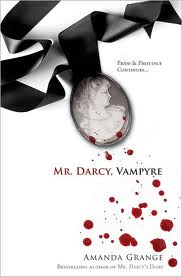
Mr. Darcy, Vampyre by Amanda Grange

Mr. Darcy, Vampyre begins with the wedding of the sisters Bennett to their respective husbands, Darcy and Bingley, and then follows Mr. and Mrs. Darcy as they go on their wedding tour. The wedding tour is supposed to be to the Lake District, but Darcy surprises Elizabeth with a wee change in plans -- they will be going to Europe instead. Relations between England and France are currently peaceful and Darcy uses this excuse to justify the change in plans. The real reason has to do with the title of the book which truly does give away the storyline. That is too bad since it would have been more fun to discover that Darcy is a vampyre. So ... now that you know this little tidbit, there isn't a whole lot to tell you since the storyline is all about waiting ... and waiting ... and WAITING for this fact to be revealed to Elizabeth. Really. More than two thirds of the book before SHE FINALLY GETS IT!!!

The atmosphere of the book is alternately sunny, then gloomy, then sunny, then suddenly gloomy. Yes, plenty of back and forthing going on. And of course when the weather and scenery is sunny and pleasant Elizabeth tells herself that the gloom, menacing characters, and howling wolves is really nothing but her imagination run wild and all is truly well with her world.

OK ... something good about the book. Well, the author did a fair job keeping Darcy and Elizabeth consistent with Austen. And I really, really, really liked the descriptions of the masquerade ball with elaborate masks, Venice, and some very colorful characters. Did I mention that there are some colorful characters? I love colorful characters. There is a particular "spooky guy" with mesmeric abilities that quite added to the strange exoticism of the masquerade ball. He had a GREAT mask. The story might be worth it just for that image alone. That and Mme Rousel who reclines on a chaise longue framed by the entrance "like a living portrait." And the Parisian women who "undulate ... across the rooms with the sinuous beauty of snakes." Ah, such decadent images!

All in all Mr. Darcy, Vampyre was a pleasant enough way to spend a couple of afternoons. I think I expected a different story than the one I got though.

I did not put this book on my challenge list, but will count it as one of my reads for the R.I.P. V Challenge.


*******************************************************
Venetian Mask photo credit: graur codrin / FreeDigitalPhotos.net

Monday, September 06, 2010

"The Old Nurse's Story" by Elizabeth Gaskell

"The Old Nurse's Story" is the first tale in Elizabeth Gaskell's collection of short stories and novellas titled Tales of Mystery & the Macabre. Many of the nine Victorian Gothic tales in this book were originally published in Charles Dickens' weekly Household Words. Gaskell wrote "The Old Nurse's Story" at the request of Dickens for a ghost story to be published in the special 1852 Christmas issue of his publication.

It is a tale that immediately grabbed me as the type that would be told around a campfire at night with all the attendant flickering shadows and night noises that go with such a setting. "The Old Nurse's Story" features a young orphan girl left in the care of her nanny and an old Aunt and the Aunt's small staff of servants. The story starts out normally enough, but with each passing page it becomes clear that there are dark secrets and strange goings-on in the old manor. The East wing is closed off and must not be entered; someone plays the old organ in the great hall on stormy nights, but it is no one currently residing at the manor; ghostly beckoning figures appear outside windows and doors. "The Old Nurse's Story" is a Victorian ghost story of the first order.

Mrs. Gaskell is better known for her social novels than she is for tales of the macabre. Her novels capture the injustices of society, the poverty stricken, and the vulnerable positions of many women and children and I did not anticipate that these themes would appear in her supernatural tales. I'm not sure why I thought this, but I was pleasantly surprised to find that she did integrate a bit of social commentary into "The Old Nurse's Story."

I encourage you to read "The Old Nurse's Story" ... preferably on a dark and stormy night!

This reading counts toward the Short Story Peril for the R.I.P. V Challenge.

Wednesday, September 01, 2010

R.I.P. V Challenge!


It's almost autumn and that means ... time for the Readers Imbibing Peril Challenge!!! This is the fifth year in a row that Carl V. has hosted this reading that focuses on what he refers to as a "very broad definition of scary." Reading that fits into the R.I.P. Challenge would be:

Mystery
Suspense
Thriller
Dark Fantasy
Gothic
Horror
Supernatural

I especially appreciate Carl's very simple rules for the Challenge:

Have fun reading
Share that fun with others

I will be joining two Perils this year:

This peril involves reading one book that fits within the R.I.P. definition.

This peril involves reading short stories that fit within the R.I.P. definition.

Here is my potential list of reads to draw from:

Novels
Fevre Dream by George R.R. Martin
(Fevre Dream would be a re-read. I believe it to be one of the best vampire novels ever!)
The Haunting of Hill House by Shirley Jackson
The Book of Lost Things by John Connolly
Any of the Dresden Files books by Jim Butcher
Something Wicked This Way Comes by Ray Bradbury
(Yeah. I read this every year. I guess it's a bit of a ritual for me. Nothing says "October" like this book!)

Short Stories
Nocturnes by John Connolly
The Vampyre and Other Tales of the Macabre by John Polidori
Tales of Mystery & Macabre by Elizabeth Gaskell
The Virago Book of Ghost Stories
(I bought The Virago Book of Ghost Stories last year from the gift and book shop at The Huntington Library. I visit The Huntington each October for my birthday and then run amok in the book shop after having tea at the Tea Room. This is yet another October ritual of mine. And I am really looking forward to this year's trip!)

Non-fiction
The Monsters: Mary Shelley and the Curse of Frankenstein by Dorothy and Thomas Hoobler

You too can join the R.I.P. fun!

Wednesday, July 21, 2010

Jamaica Inn by Daphne du Maurier

Jamaica Inn is a wonderfully atmospheric book with plenty of Gothic elements, and I do so love Gothic! The opening scene of the 1939 Hitchcock movie version of Jamaica Inn, all dark and stormy and eerie, was in my mind as I picked up this book hoping for something with "mood" and setting. I was not disappointed as you can see by this wonderfully "gray" opener:

"It was a cold grey day in late November. The weather had changed overnight, when a backing wind brought a granite sky and a mizzling rain with it, and although it was now only a little after two o'clock in the afternoon, the pallour of a winter evening seemed to have closed upon the hills, cloaking them in mist. It would be dark by four. The air was clammy cold ..."

A "mizzling rain." I'm not even sure what mizzling is, but it sure does bring up an image in my mind.

The story takes place in the early 1800s on the Cornish coast. The main character is Mary Yellan, a strong willed and independent young woman who promises her dying mother that she will sell the family farm and go to her Aunt Patience and Uncle Joss Merlyn. Mary's mother is afraid that it will be too hard for a single woman to maintain the farm and wants an easier life for her daughter. Mary honors her mother's dying wishes even though she would really like to stay near her sunny, friendly village and farm the family property.

Mary has only met her Aunt Patience once and remembers her as a vibrant, vivacious woman. The woman she finds when she arrives at Jamaica Inn, on a cold and stormy night, is not even recognizable. Aunt Patience is a shell of a woman, frightened of her own shadow. Uncle Joss is a big, mean man radiating evil intent. Jamaica Inn is in a state of utter decay and, despite its position on a main road, has no traveling customers. All of the locals know it as an evil place and coach drivers hurry past without stopping.

There are plenty of mysterious midnight goings-on that Mary has been warned to ignore. Of course, you can't have a heroine that ignores mysterious midnight goings-on! Mary soon learns that there is true evil and what that evil can look like. I can't tell you more about that without seriously spoiling the story, so you will just have to read it. *smile*

There is a romance within the story that took me by surprise. Mary is attracted to Jem, the proverbial "bad boy." Jem, a horse thief, is the younger brother of Uncle Joss and Mary is wary of her feelings for him. After all, he is a Merlyn man. Again, I can't tell you more about this without spoilers. I will tell you that I was a bit surprised at the way this aspect of the story resolved and I'm not sure what I think about the way the book ended.

I particularly enjoyed the setting and the contrast the author creates between the sunny village of Mary's childhood and the stormy, windswept moors and stark coastline of Jamaica Inn. The decay and lurking evil are palpable. The characters are much like the physical settings. Mary has a sunny disposition and radiates confidence and an inner happiness, while the other characters are dark and display an inner decay.

I loved the character of Mary Yellan. I liked her strength and independence. It is rather odd to have such an independent woman for the time period of the story; perhaps this was a bit of 1930s seeping in through the author. Still, even with the disconnect, the strength of this character kept the story from becoming depressing.

This book is definitely a keeper that I will read again in the future. I'm looking forward to watching the old Hitchcock version again, now that I've read the book, so I can compare!

Jamaica Inn was my selection for The 1930s Mini-Challenge hosted by Nymeth at things mean a lot and one of my selections for the Daphne du Maurier Challenge hosted by Chris at Book-A-Rama.


Thursday, November 19, 2009

Women Unbound Challenge: A few more books and a request for a recommendation

I created my reading list for the Women Unbound reading challenge and, of course, I now want to add a few more titles to my list. Will I read everything on my list? Probably not by the time the challenge ends, but I like to create reading lists. It's always nice to have a reading list available to consult in those moments when I feel like reading a particular type of book.

So ... I woke up in the middle of last night and thought: "HEY! I have The Golden Notebook: A Novel by Doris Lessing on my TBR tower and it would be perfect for the Women Unbound reading challenge!" This thought then led me to mentally review my bookshelves and I came up with The Left Hand of Darkness by Ursula K. LeGuin. Yup, the book geekiness just never quits. One of these nights I will not wake up and start thinking about books I want to read.

Then, while moving a pile of books this morning, I noticed Pink Think: Becoming a Woman in Many Uneasy Lessons by Lynn Peril. Why I didn't put this on my initial list I will never know.

Now for my request for a recommendation. I recently watched the movie Frida (with Salma Hayek) and really enjoyed it. Now I want to read a book about her. I did identify one that looked interesting: Frida: A Biography of Frida Kahlo by Hayden Herrera. What book about Frida Kahlo would you recommend I read? Have you read the biography by Hayden Herrera and what did you think of it?

Monday, November 16, 2009

I Am a Cat, Volume 1 - Discussion

I'm currently working my way through I Am A Cat by Soseki Natsume along with a few other people. You can find links to the read-along (hosted by Tanabata at In Spring it is the Dawn) over on my sidebar. Tanabata has provided some very nice background information in her post for the discussion of volume one. She has also provided some questions to get the discussion going and I'm going to use those here.

What do you think of the story so far? The schoolteacher? The cat? The schoolteacher's 'friends' who are always telling tall tales?

I find the story delightful. I happen to love satire and have had so much fun "listening" to the cat's commentary on the humans.

The dyspeptic schoolteacher is amusing. So far we know that he is lazy and pretty focused on his digestive system, begins projects and then abandons them, tries to write haiku and prose (badly, I might add), and acquires many books that he never reads. I'm sure it is a part of the satire that we never see him in his teaching role.

The cat is likeable (sp?). I enjoy the way the author has softened the satirical edge by using a feline to comment on the humans. Toward the end of volume one I noted that the cat is becoming a bit more narcissistic and snarky in a human kind of way. I'm wondering if this progression will continue and if some of the "charm" in the telling of the story will be compromised by this.

The "friends" do tell some TALL tales with sometimes quite bizarre embellishments. I especially like the "culture vulture" who is always monitoring the cultural savvy of others when he is so very clueless and gauche himself. The obsession with "hanging" as either a suicidal event or a form of execution is peculiar to me. Not sure what to make of that one. I'm guessing this is something cultural.

Have you had any difficulties reading the first volume? Any burning questions? What impression do you have of Japan from this portrayal?

The book is not plot driven and is more appropriately approached as a succession of vignettes. It is also written in a very Western style which makes it highly accessible to current readers. I appreciate the satire even when I don't quite understand the cultural context. The commentary is universal enough to apply across cultures (at least it seems to cross over to Western culture as I've experienced it). No burning questions. I have already mentioned the curious obsession with "hanging." I'll be going back to more carefully explore the cultural references and links provided by Tanabata in her discussion of volume one.

As it's a satire, what do you think the author is saying about Japan, and this class of people? What name would you give the cat, if you could? Or do you like the fact that he remains nameless?

I LOVE the fact that the cat remains nameless. That the characters are so caught up in themselves they can't even be bothered to give the cat a name definitely fits the author's commentary. Leaving the observer/narrator nameless serves to take a bit of the personal edge off of the rather biting comments the author makes about certain classes of his countrymen.

I Am a Cat by Soseki Natsume is a part of my reading list for the Japanese Literature Challenge 3 hosted by Bellezza.

Thursday, November 05, 2009

A New Challenge: Women Unbound


Women Unbound Reading Challenge
"Participants are encouraged to read nonfiction and fiction books related to the rather broad idea of ‘women’s studies.’ "
November 1, 2009 - November 30, 2010


I've been thinking about the Women Unbound reading challenge ever since Eva first blogged about it. I try not to over commit myself with challenges, but I think I've got my reading commitments spaced out well enough to join in this one. Joy!

In order to make sure I retain my sanity, I'll commit to the Philogynist level and read two books, one of them non-fiction. By only committing to read two books I can feel super successful when I end up reading more than I committed to! Yeah, I like to play mind games with myself.

Here is a preliminary list of books. All of these books are on my TBR pile. How convenient is that?

Non-fiction
Geisha: A Life by Mineko Iwasaki (main informant for Memoirs of a Geisha by Arthur Golden)
Gertrude Bell: Queen of the Desert, Shaper of Nations by Georgiana Howell (biography of a famous British traveler to the Middle East)
A Room of Ones Own by Virginia Woolf (a classic I never got around to reading)
Subject to Debate by Katha Pollitt (political essays)
Persepolis by Marjane Satrapi (a graphic memoir)
Pink Think: Becoming a Woman in Many Uneasy Lessons by Lynn Peril
Frida: A Biography of Frida Kahlo by Hayden Herrera

Fiction
Cranford by Elizabeth Gaskell
Tender Morsels by Margo Lanagan
Tipping the Velvet by Sarah Waters
Cheri by Colette
Purple Hibiscus by Chimananda Ngozi Adichie
Kristin Lavransdatter by Sigrid Undset
The Golden Notebook by Doris Lessing
The Left Hand of Darkness by Ursula K. LeGuin

Tuesday, November 03, 2009

R.I.P. IV Challenge Wrap Up

I can't believe that this year's R.I.P. Challenge, hosted by Carl V., is over. It went too fast for me to get to all of the books I wanted to read. I only committed to read and review one book for this challenge, but I was having too much fun and ended up reading seven and reviewing three.

Here are the books I read:

The Ghost Writer by John Harwood [review] - I liked this one well enough, but what I really enjoyed were the ghost stories within the story.

The Seance by John Harwood [review] - Out of the two Harwood books, I liked this one best. The author seemed to do a better job developing and pacing the story with this one.

We Have Always Lived in the Castle by Shirley Jackson - Disturbing. Very disturbing. In a good way of course! I can't recommend this one enough.

The Glass Books of the Dream Eaters, volumes 1 and 2 by Gordon Dahlquist - Total steampunk. Probably didn't need to be quite as long as it was, but I still enjoyed it a lot. I will forever have images in my head from this book!

The Little Stranger by Sarah Waters [review] - Wonderfully atmospheric. I didn't really like any of the characters in this book, but that didn't keep me from enjoying it anyway.

Sunshine by Robin McKinley - McKinley manages to cover some new vampire territory with this one. Has one of the most tense human/vampire scenes I've ever encountered.


I only read part of this collection of short stories, but hope to finish it:
Tales of Moonlight and Rain by Ueda Akinari (also reading for Bellezza's Japanese Literature Challenge)


These are the books I didn't get to, but will definitely be reading in the future:
The Haunted Hotel by Wilkie Collins
The Girl With the Dragon Tattoo by Stieg Larsson
The Vampyre by John Polidori
The Monsters: Mary Shelley and the Curse of Frankenstein by Dorothy and Thomas Hoobler
Something Wicked This Way Comes by Ray Bradbury (re-read)

Tuesday, October 27, 2009

BOOK REVIEW: John Harwood Novels


I thought I'd post a double review of the two John Harwood novels I read recently for the RIP IV Challenge. I started with The Ghost Writer (because he wrote that one first, of course!) and then, because I enjoyed it so much, I followed it up with The Seance. I would describe both novels as Gothic mysteries. Harwood uses Gothic elements to bring a nice chilling atmosphere to both books, [SPOILER ALERT] but early on I suspected a human rather than a supernatural cause to the bizarre happenings in his two novels and therefore consider the books more mystery than ghost story. [END SPOILER ALERT] The author didn't appear to try and hide this aspect so I don't consider the knowledge beforehand to be a terrible spoiler, but I realize some would not want to know this.

The Ghost Writer begins in Australia with ten year old Gerard Freeman unlocking a secret drawer in his mother's room and discovering a picture of a woman he has never before seen. But why the mystery? Why is her picture locked up in a secret drawer? Who is she? Why is his mother so secretive and controlling? It takes the majority of the book to discover the answers to these questions.

Gerard's mother often describes Staplefield, her childhood home in England, to the young boy thereby creating a longing in him to one day travel to this lush land of shady dells and leafy bowers. In his loneliness, thirteen year old Gerard begins a correspondence with an English "penfriend" named Alice Jessel. Alice is a thirteen year old orphan confined to a wheelchair in an institution that, by her description, seems a lot like Gerard's image of Staplefield. Odd, no? Many years of correspondence occur before Gerard decides to travel to England to meet Alice, despite her assertions that she is not yet prepared to see him in person.

True ghost stories, the creation of Gerard's great grandmother, are interwoven throughout the Gerard and Alice narrative. They are Victorian tales of the supernatural and are truly spine tingling. I actually enjoyed these stories within the story more than I enjoyed the main account. Gerard discovers the ghost stories one at a time in very curious ways. The stories are even more chilling because they mirror, or precede, events in the main narrative. It is as though the ghost stories begin to bleed into the main storyline and give a sense that Gerard is being led by someone or something that wants him to discover the truth of a horrifying past.

I will admit that I had to read the ending of The Ghost Writer more than once in order to "get it." I've heard others say that they too had to read the ending more than once and some have said they never did feel that they understood the ending. This might make the book a good choice for a book club read!

Interesting bit: Those familiar with Henry James's Miss Jessel and Dickens's Miss Havisham will recognize Harwood's rather obvious, but fun, nod to those characters through his own spinster characters.

After reading and enjoying The Ghost Writer, I was glad that I already had The Seance at hand so I could read it right away. The Seance is set in Victorian England making it even more amenable to Gothic elements than The Ghost Writer. A cursed and ruined mansion with secret passages and hidden rooms, unexplained footsteps, foggy moors and forests, a sarcophagus set into an unused fireplace, a blackened suit of armor looming in the shadows, mysterious and powerful flashes of light and an apparatus for collecting electricity from lightning strikes. What more could a Gothic loving reader wish for?

The narrative is nested and delivered through the voices of three separate characters -- Constance Langton, Eleanor Unwin, and John Montague. Constance Langton is the narrator of the story. She is alone in the world when she finds out that she has inherited Wraxford Hall, along with a packet of papers, from a distant relative. She is advised by the family's lawyer to dispose of the cursed mansion ... even if it means that she must burn it to the ground. Wanting to know more about her family, Constance opens the packet of papers where she finds the diary of Eleanor Unwin who, along with her infant daughter and villainous husband, disappeared 25 years ago from Wraxford Hall. It is believed that Eleanor murdered her husband, and possibly her baby daughter, before disappearing. But Eleanor tells a much different story in her secret diary and her account is supported through the words penned by the family lawyer, John Montague, in his own diary included in the packet of papers .

Constance believes Eleanor Unwin is both innocent and possibly still alive, and sets out to solve the mystery and scandal surrounding Eleanor and Wraxford Hall. The narratives of both Constance and Eleanor are eventually meshed to provide a thrilling end to the mystery and the reader is left to contemplate the monstrous in human form.

Having recently read Ghost Hunters: William James and the Search for Scientific Proof of Life After Death by Deborah Blum, I particularly enjoyed the competing paranormal and Victorian scientific claims of the late 1800s that Harwood includes in The Seance. Throughout the latter 19th century and into the early 20th century, the Society for Psychical Research sought to bridge the gap between faith and science and find scientific proof for the supernatural. Harwood makes excellent use of this tension in telling his own tale.

Interesting bit: I love Harwood's modern twist to a tale set in Victorian times. "The strongest characters in The Seance are two women of action." (Quote taken from a Washington Post review.)

Friday, October 23, 2009

BOOK REVIEW: The Little Stranger by Sarah Waters

Title: The Little Stranger
Author: Sarah Waters
Publisher: Riverhead
Year: 2009
Reason for reading: RIP IV Challenge

First line: "I first saw Hundreds Hall when I was ten years old."

The Little Stranger is a deliciously spooky book that kept me reading into the wee hours of the morning ... with all the lights on, of course! The story opens with Dr. Faraday remembering his first visit to Hundreds Hall in 1919 when he was ten years old. His mother worked as a parlor maid for the Ayres family at the time, and young Faraday was quite taken with the house. Thirty years later Dr. Faraday, a bachelor, is called to Hundreds Hall to treat a servant. He becomes obsessed with both the house and the elegant Mrs. Ayres and her two grown children: Roderick, an RAF airman wounded during WWII and Caroline, a spinster who Dr. Faraday is both attracted to and repulsed by at different times.

Faraday becomes a regular visitor at Hundreds Hall despite the class differences between himself and the Ayres family. The British class system is fading and times are difficult for those who previously earned income from their estates. Many of the landed are selling their properties outright; but not the Ayres. The Ayres choose to dissect their property to developers bit by bit. The Ayres family try to maintain their status as landed gentry even though it is clearly taking a toll on the health of Roderick who oversees the estate. Hundreds Hall is in a state of severe decay and it quickly becomes apparent that the Ayres family is also disintegrating as odd behaviors begin to display. I don't want to give away too much, but in Gothic tradition there are eerie and unexplained events, violence, madness and suicide.

That there is malevolence afoot can not be denied, but it is not clear whether the malevolence is of supernatural or human origin. Is the house itself malicious? Is it inhabited by ghosts and poltergeists? Or is the psychological decay of the family creating an atmosphere and energy that result in horror? [SPOILER ALERT] For those who like tidy endings, these questions might be a sticking point as it is never entirely clear what caused the "madness" at Hundreds Hall. [END SPOILER ALERT]

The Little Stranger is my first book by Sarah Waters, so I cannot compare it with her previous work. I do think that this book has similarities to some of Shirley Jackson's work. I recently read We Have Always Lived in the Castle and [JACKSON SPOILER ALERT] like Waters, Jackson used the psychological deterioration of her characters to create a disturbing and chilling atmosphere. [END SPOILER ALERT]

I've heard that one of Waters strengths is her historical settings. I think she has done a marvelous job with The Little Stranger placing the reader in post-WWII England circa 1949. There were times that I forgot I was reading a contemporary novel.

Highly recommended.


**********************
Also reviewed at:
an adventure in reading
Fizzy Thoughts