Friday, October 27, 2006

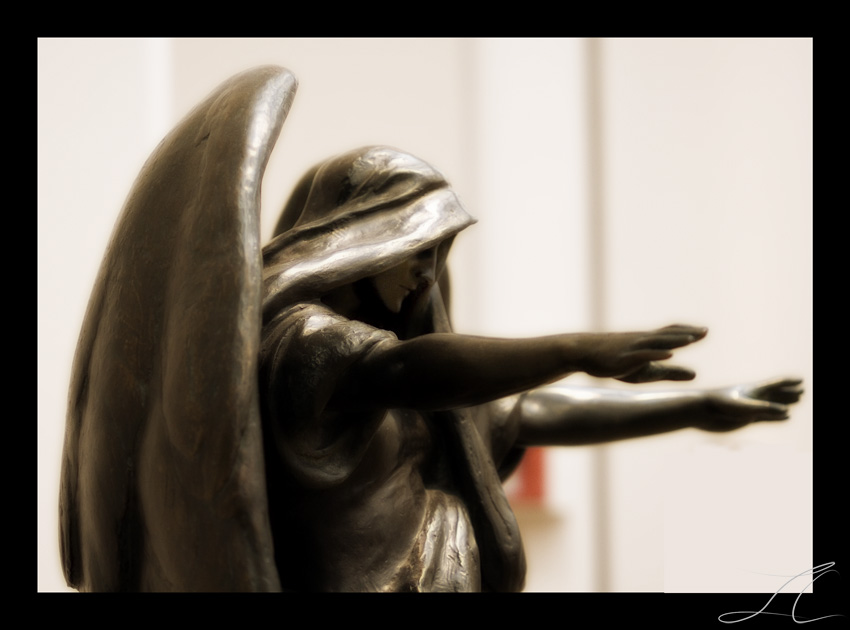
Benediction

Photo courtesy of Leo Chen

ben-e-dic-tion n. 1. a blessing

I recently took a trip to The Huntington to spend some time walking the gardens and viewing the art collections. The nice thing about living so close to a place like The Huntington is the chance to spend quality time. There is no need to rush through and visit all of the gardens or all of the exhibits in one day. Instead, you can go for tea and then visit the Shakespeare Garden. Come back another day and visit the Japanese Garden and the Chinese Art Exhibit. This particular trip I went for tea, visited the Japanese Garden, and then spent a fair amount of time in the Scott Gallery and the Erburu Gallery viewing some very famous American and European paintings by artists such as Edward Hopper, Mary Cassatt, Gainsborough and Reynolds.
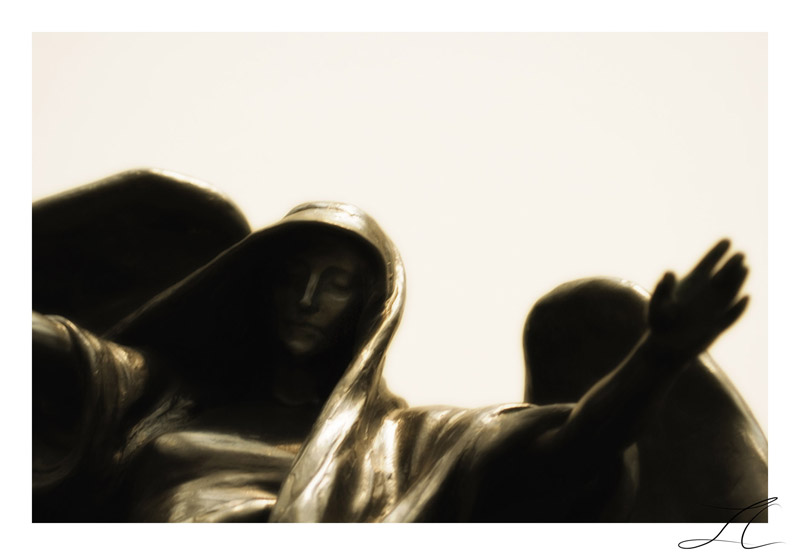
Photo courtesy of Leo Chen

Though I enjoyed these paintings, I was most intrigued with a bronze sculpture titled Benediction, by Daniel Chester French. French is perhaps most famous for his sculpture of Abraham Lincoln that stands (or rather sits) in the Lincoln Memorial.
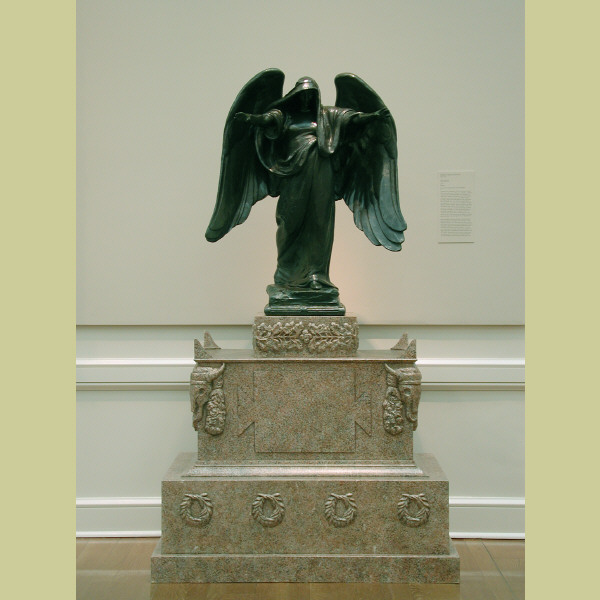
Benediction "was modeled in 1922.... A sixteen-foot version of Benediction was to have been the centerpiece of a monument near St. Mihiel, France, honoring soldiers from Massachusetts who had died in the First World War. The shrouded, winged figure, a recurring image in French's work, would have hovered high above the recumbent figure of a soldier covered by an American flag, offering a final blessing. Neither the monument, ... nor the full-scale sculpture, was ever made, though four smaller versions of Benediction, including [the one at The Huntington], are known to exist."
Information & Photo courtesy of The Huntington

This sculpture, on its base, stands perhaps 7 feet high. I was intrigued at first glance since the sculpture appears a bit ominous with its shrouded figure and dark bronze coloring. I moved on to take a look at a few other sculptures in the room and found myself back at Benediction for another look. This time I got down low to the ground and looked up into the face of this angel with outstretched arms and noticed the peaceful look of blessing. I could hardly breathe for the emotion that this drew. I then moved into another room to look at some paintings, but found myself returning to stare at Benediction some more. At the third (and not last) visit to this sculpture that continuously drew me back, I began imagining what it would have looked like at its full 16 foot height, not including the large base that it would have required. The power and beneficence that this sculpture would have exuded as it hovered over a flag draped fallen soldier would have been enormous. I am sorry that the monument and full-scale sculpture were never executed.

It is rare that I experience this kind of reaction to a piece of art. I have been drawn to various pieces in the past, but never this powerfully. I am a reader, and sometime writer, who easily recognizes the great power of words. This visit to The Huntington reminded me of the great power of images.

For those who have an interest in photography, I encourage you to visit Leo Chen's website. He has some amazing photos on display. As I searched around for images of Benediction, the only ones I found that came close to capturing what I felt as I viewed this sculpture were the two Chen photos presented in this post.

Wednesday, October 18, 2006

The Blessing of Grandmothers

I spoke with one of my grandmothers over the weekend and was suddenly overwhelmed with emotion in the middle of our conversation. I realized in that moment how enormously blessed I am, at my age, that both of my grandmothers are still living. Grandma B. is 89 and Grandma Y. is 88. Astounding to even think about.

I have written previously about Grandma B. and how alzheimers is slowly taking her away from us. It is truly a "long goodbye," but there are still little blessings associated with that relationship. For instance, I received a birthday card this month from my aunt and inside that card was a handwritten message from Grandma B. that read, "I love you a bushel ... and a hug around the neck." I was surprised to see this message from her. It was completely unexpected. Her mind would only let her remember a part of this favorite saying, but I understood that message of love and my mind filled in the blanks. "I love you a bushel and a peck and a hug around the neck" too, Grandma.

I don't get to visit Grandma Y. very often since she lives on the other side of the country, but we talk on the phone and write letters. Yes, letters ... using pen and paper. Various family members have attempted to get Grandma online and using email, but she "won't have any of that fancy electronic stuff." The telephone is about as technologically savvy as she is willing to get. We talked across that marvel of technology for over an hour this last weekend. We talked about a little bit of everything, but my moment of illumination came when the conversation turned to grandchildren. My Grandmother has had 6 grandchildren. I have 3 granddaughters. I found myself, for the first time, talking "grandma to grandma" with my Grandmother about grandchildren. How many women get to have that conversation!

I wrote recently about my wonderful book filled birthday, but the gifts I cherish most these days are not tangible. They are the gifts of relationship. Hearing from BOTH of my grandmothers this birthday was the best gift I received, and it was made sweeter since it was not expected. I don't know how long this Blessing of Grandmothers will last, but I will never again take this blessing for granted and I will truly cherish those I've already received.

Tuesday, October 10, 2006

Books! Books! Everywhere, Books!

Have you ever read the beginning of Italo Calvino's If On a Winter's Night a Traveler? Calvino begins this story with a character who loves books; he loves the feel of them, the smell of them, the words in them, and most importantly the stories and ideas in them. After purchasing a new book, he opens the front to see the title page. He looks at the cover and then turns it over to look at the back. He literally caresses that new book! When I first read this opening passage, I felt an overwhelming sense of familiarity ... that character could be me.

I wrote a poem based on this bit of book love by Calvino. I called it "Book Lust." I know, I know ... Nancy Pearl used this phrase as the title of one of her books. But I wrote the poem long before Book Lust was published. Ms. Pearl was just more motivated than I was, at the time, to put her work out there for the world to see. Sniff.

So how serious is my book lust? Well, for starters I've got 849 titles listed in my LibraryThing.com catalog and this is just the tip of it. I still have "a number" of books in storage that need to be entered into my catalog. To be fair, not all of these tomes are mine. Mr. Distortion is quite a reader too and he is not immune to the siren call of books.

The extent of my book lust was brought home to me last night when I took a trip to Borders Books. With birthday gift certificate in hand, I went skipping into the bookstore. Well, I didn't actually skip, but I wanted to ... and I was skipping in my head. I had a list of desired titles and began my search:

  • The Complete Brothers Grimm Fairy Tales? Nope, but Borders said they could order it for me and have it in 7 days. Hmmph. Want. Book. Now.

  • A Graveyard for Lunatics: Another Tale of Two Cities by Ray Bradbury? Nope, but there were about 25 copies of Fahrenheit 451 waiting for someone to love them.

  • Something Rotten (Thursday Next Novels) by Jasper Fforde? Nope, but they had the other 2 titles in this series that I already own.

  • The Cambridge Companion to T.S. Eliot by A. David Moody (ed.)? Nope, the computer said it was "in store" but appeared to be lost misshelved.

    Anyway, you get the idea. I decided that I might have more success if I just browsed the shelves. Certainly I would serendipitously come across a title that I really-really-wanted and had failed to put on my list. Browsing, I was a bit surprised at the number of books that I'd either read or already own, but I valiantly forged ahead with occasional sighs and "hmmms" to renew my determination. Eventually those sighs must have alerted the sales staff that they had a reader-in-distress in their midst, and a very nice saleslady asked if she could help me find anything. Before I had given careful thought to my answer I heard the following words come out of my mouth: "I think I have everything in the store already." The saleslady just stared. Probably hadn't heard that one before. So I added, "But thanks anyway," just to be social. Geesh! What IS my problem??

    I finally came home with Friends, Lovers, Chocolate by Alexander McCall Smith. Finding this book was no easy task since bookstores are never sure where to shelve it. Does it get shelved in Mysteries or Fiction/Literature? Does it get shelved with the M's for McCall or the S's for Smith? Just for the record, I found Alexander McCall Smith's books in all of the aforementioned areas.

    I must say that this has been a good birthday. Friends and relatives have fed my insatiable book lust with nary a hint of forthcoming intervention. What is that I hear you asking? The rest of the booty?

    I submit Birthday Gifts 2006:

  • I Am a Cat: Three Volumes in One by Soseki Natsume
  • Shakespeare Cats by Susan Herbert
  • Why I Write by George Orwell
  • The Man Who Was Thursday: A Nightmare by G.K. Chesterton
  • The Sunday Philosophy Club by Alexander McCall Smith
  • On the Beach by Nevil Shute
  • The Scar by China Mieville
  • Reading Like a Writer by Francine Prose

    Now to find those hours upon hours to read - ay, there's the rub.
  • Monday, October 02, 2006

    Six Degrees of Booking ... or Seven

    Six Degrees of Booking is a game that I first heard about through Mary at Life, the Universe and Everything. Mary heard about it at Booking Through Thursday. There is a current round being played, so if you'd like to play along simply leave a comment here with your own list or tell us where to find your Six Degrees of Booking.

    To play, simply connect any six books that you have read. The connections can be personal to you or drawn from the book or authors. I have started with the book I'm currently reading.

    1. Cloud's Rider by C.J. Cherryh. This book is part of a set of two that begins with Rider at the Gate. Humans have colonized a small piece of a distant planet where the native fauna are telepathic. This telepathy creates a constant state of tension and agitation as the animals both receive and send the thoughts and emotions of the humans. The author's ability to portray this mental landscape and transmit its tension and agitation to the reader is an astounding bit of writing. Another writer who has used this tension building device that places the reader into quite a disturbed mental "state" is Fyodor Dostoyevsky in The Idiot.

    2. There is a lengthy passage in Dostoyevsky's The Idiot that slowly increases the mental agitation of the reader, though you may not realize it until you find your brain falling apart at the climax of the passage. What you, the reader, might not realize until the end of the passage is that you are being taken on a disturbing inner journey that concludes with the character's epileptic seizure.

    3. While some journeys focus on the interior landscape, William Least Heat-Moon takes you on a journey of the back roads of the United States. These small highways show up on older highway maps as blue lines, hence the title of his book Blue Highways. The author has just suffered the loss of both his job and his wife and sets off on a journey to "meet life" and in the process writes some pretty amazing literary portraits of average Americans. While Heat-Moon's Blue Highways is an ode to the back roads of America and it's ordinary citizens, ...

    4. ... Edward Abbey's Desert Solitaire is an ode (of sorts) to the canyonlands of America's deserts. If one can get past Abbey's rants against the United States government, the reader is rewarded with loving and beautiful descriptions of a place that is slowly being lost to commercial interests. The sense of a time and place slipping away can also be found in ...

    5. ... Memoirs of a Geisha by Arthur Golden. Golden's first novel portrays a now-vanished way of life in Japan of the 1930s and 40s.

    6. The Japan of the 1930s and 40s found in Memoirs of a Geisha is quite different from the Japan of the late 1960s and early 70s depicted in Norwegian Wood by Haruki Murakami. Norwegian Wood is a bittersweet coming of age story about a young man at university in the Japan of 1969-70.

    7. Another coming of age novel is The Stolen Child by Keith Donohue. In The Stolen Child, Donohue takes us through the poignant task of leaving our identity as a child behind and learning to live as our adult self. This story cleverly uses the myth of the changeling to accomplish the task of showing how we are both one and other to our child and adult selves.

    POSTSCRIPT: This last book very neatly takes me back to the top of my list with Rider at the Gate and Cloud's Rider. This set also happens to be a coming of age story and a story of being both one and other via the telepathic connection. I didn't intend to make a circle here, but it conveniently worked out that way.

    POST POSTSCRIPT: After posting this, I realized that I made a list of seven rather than six. So you get a freebie on this run!